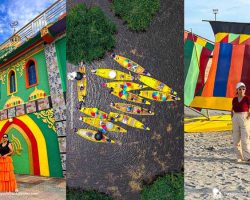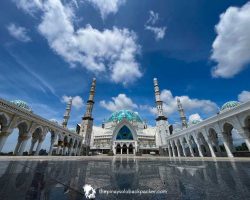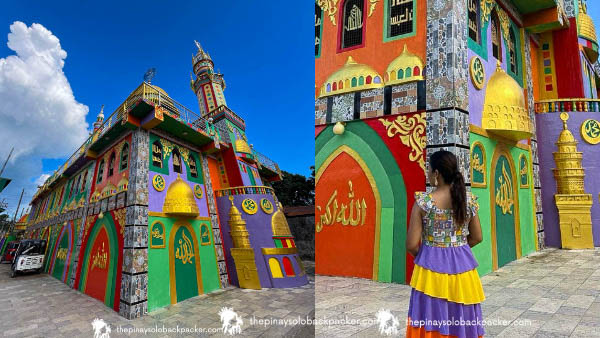
Detailed DIY travel guide and how to get to the Rainbow Mosque Zamboanga. Also includes the history of the Zamboanga Rainbow Mosque, its architecture, design, and color symbolism.
There are places you visit because they are famous, and there are places that make you stop and get curious, “Why is this here?”
The Rainbow Mosque in Zamboanga City, officially known as Masjid Al-Islamia, was one of those places for me. I’ve seen photographs of its vivid colors before traveling to Zamboanga City, but photographs don’t quite prepare you for seeing this mosque in person.
I solo traveled to Rainbow Mosque in Zamboanga thinking my travel buddies already left me because they weren’t replying. So, I hired a tricycle outside our hotel and made my way to the colorful Masjid Al-Islamia in Brgy. Sta Maria.
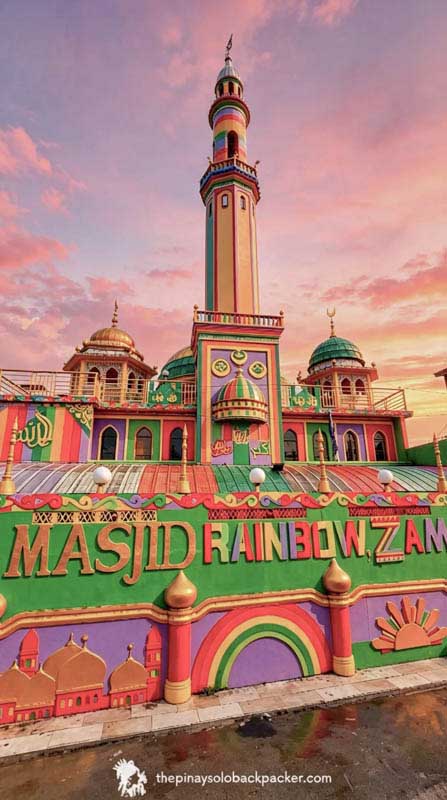
Along the busy road in Brgy. Sta. Maria, the structure ascends from the daily cadence downtown – the gradual traffic, the metallic chug of passing tricycles, the diesel-heavy roar of jeepneys shifting gears, the bustling shops and the muffled chatter of people going about their day – with a dome and minaret, painted in flamboyant colors.
It is impossible not to look.
But after spending time here, I realized that the Rainbow Mosque in Zamboanga is much more interesting than simply being a colorful mosque or a photogenic Zamboanga City tourist spot. Its colors, location, architecture and relationship with the surrounding community offer a fascinating way to understand faith, identity, memory, diversity and peace in Mindanao.
And as a solo traveler, that made my visit here more meaningful.
TRAVEL BLOG CONTENTS
HISTORY OF RAINBOW MOSQUE ZAMBOANGA
Long before its iconic multi-colored dome caught the attention of travelers and photographers, Masjid Al-Islamia (Rainbow Mosque Zamboanga) had deep community roots.
When was the Rainbow Mosque in Zamboanga City built?
The exact year Masjid Al-Islamia was originally built is not well documented in readily available sources. However, I went down a rabbit hole and found out that there is said to be a specific interview discussing this from local regional news broadcast that is often shared via local news segments like ABS-CBN’s One Mindanao. However, I couldn’t find a direct hyperlink to the original broadcast page. But it is said that according to the interview of Rainbow Mosque Zamboanga’s caretaker Bilal Abdulbari, the mosque was built in 1970 by the local Maranao community and was formerly painted in white and green.
The Maranaos are the indigenous people of Lanao Region (the provinces of Lanao del Sur and Lanao del Norte). Their ethnonym literally translates to “People of the Lake” (“ranao” or “ranaw” meaning “lake”). The mosque served as a quiet neighborhood sanctuary for decades before undergoing a significant expansion and development phase in 2009.
And according to Bilal Abdulbari, the mosque’s caretaker, the transformation was born from a profound message of harmony. He explained in local documentation that, “Islam means peace. My boss thought of peace, and made it many colors to symbolize different races and tribes that need to unite.”
I did check the meaning of Islam, it literally means “submission” or “surrender” to the will of God “Allah”, but it shares the root with the Arabic word “salam”, which directly translates to peace.
Anyway, during my visit, I noticed there are apartment-style houses inside the Rainbow Mosque complex where some locals live. But I was quite shy to approach them and ask about the mosque’s history.
Thankfully, later on, my travel buddies finally arrived at the mosque with a local tour guide and tour operator of Itravel Tourist Lane – Errol Bayona (you can BOOK his ZAMBOANGA CITY TOUR HERE) who explained to us the symbolism of the Rainbow Mosque of Zamboanga. Turns out they were still sleeping when I left that’s why they’re not replying. LOL
Why is Rainbow Mosque painted in rainbow?
If you search online for Rainbow Mosque in Zamboanga City, the most common question is, “Why is the Rainbow Mosque painted in rainbow colors?”
The answer is rooted in modern history. Sudden dramatic shifts in public aesthetic almost always responses to collective trauma or societal transition.
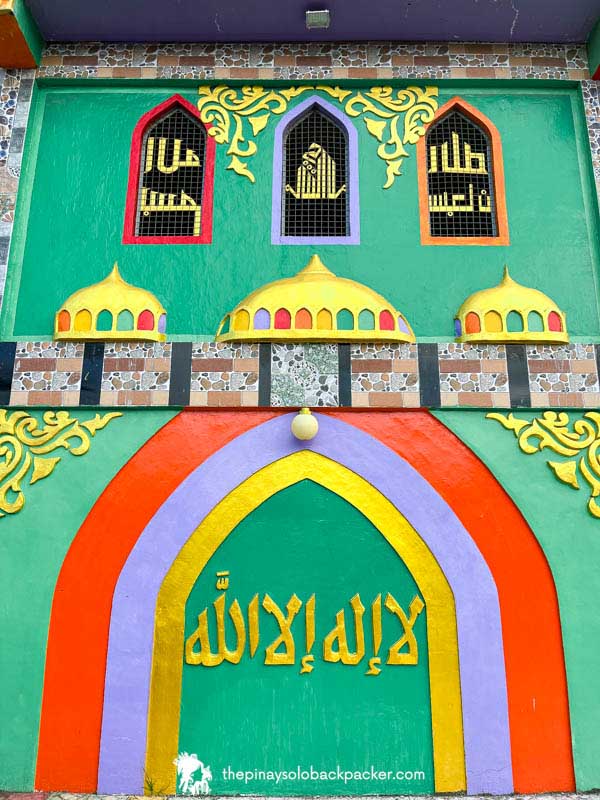
For years, the mosque stood as a traditional, unassuming house of worship. According to Errol Bayona, our local tour guide, following the 2017 Marawi Seige – an event that deeply fractured regional identities across Mindanao – , the mosque was repainted in vibrant rainbow colors by the local community to make a profound statement, transforming it into the landmark now known as the Rainbow Mosque – a visual symbol associated with peace and unity, a tribute to the fallen heroes.
By repainting the exterior into a brilliant gradient of colors, they turned architecture into an active agent of social healing. It stands as a living material culture artifact: a public, joyful declaration that pluralism, shared vulnerability, and mutual respect are the true core of Zamboanga society.
Because if you want to make a statement to the Muslim community in the Philippines, you do it in Zamboanga City. This lively metropolis in southern Mindanao holds immense symbolic and strategic importance regarding Muslim-Christian relations and the peace process in Mindanao. Local institutions like the Ulama Council of Zamboanga Peninsula frequently use Zamboanga City as a base to release joint statements calling for calm, interfaith harmony, and unity across religious lines during times of regional conflict.
Zamboanga City holds one of the largest urban Muslim population in Mindanao, outside the Bangsamoro region, as per the data from the Philippines Statistics Office – Mindanao. Interestingly, the Muslim population here is only approximately 35% of the city’s total population while Roman Catholics population is about 57%.
RAINBOW MOSQUE ZAMBOANGA ARCHITECTURE + SYMBOLISM
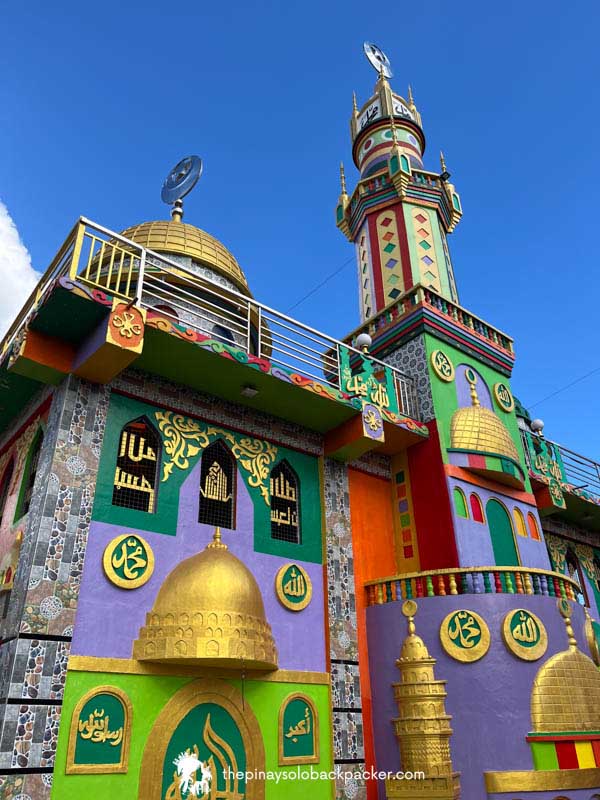
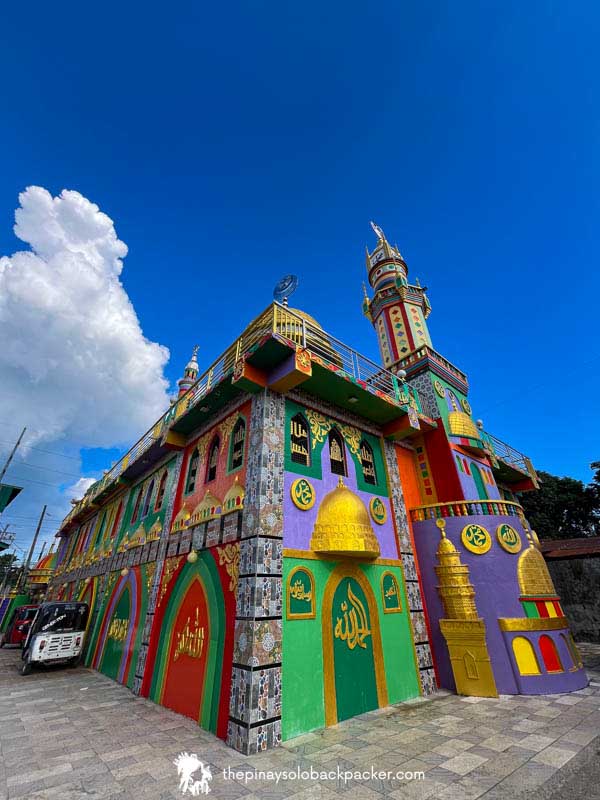
I must admit that the brilliant bands of color arc across the main dome and façade, is what convinced me to visit Rainbow Mosque Zamboanga.
Yet as I look the initial splash of color, I spotted a deep traditional craftmanship at work:
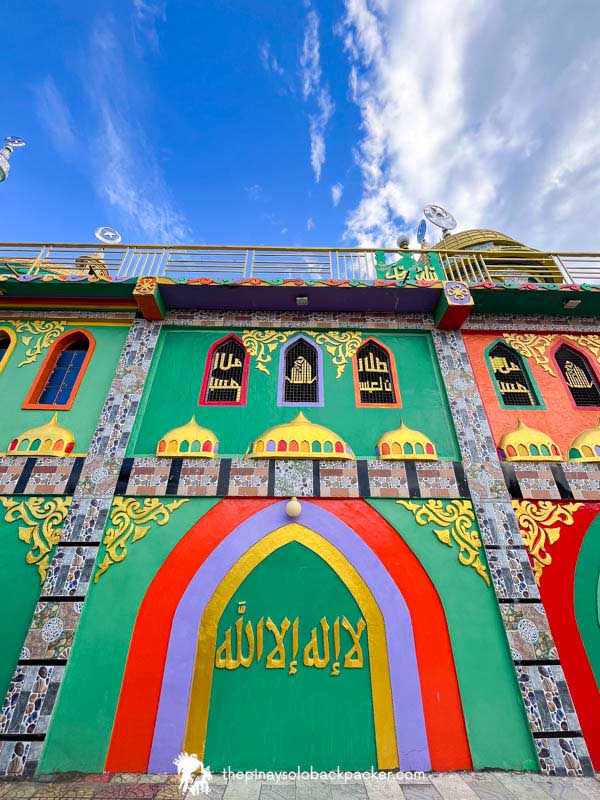
- The Multi-Color Significance: The mosque’s rainbow palette acts as a visual macrocosm of Zamboanga’s social fabric – a reminder that a pluralistic society derive its strengths not from assimilation into a single shade, but from distinct, vibrant identities standing side by side.
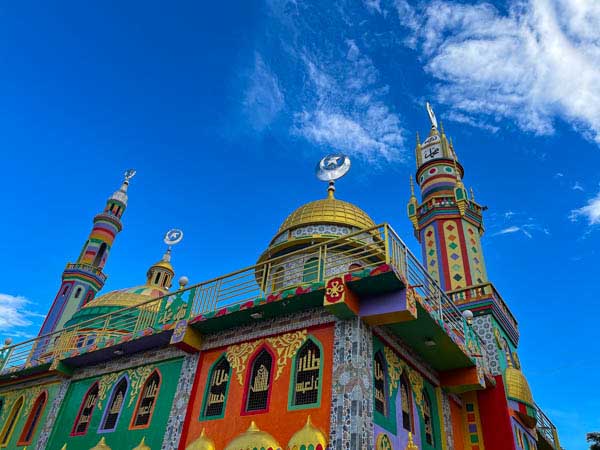
- Indigenous Motifs: Traditional indigenous motifs frame the windows and doorways of the Rainbow Mosque in Zamboanga City. The juxtaposition is vital: it proves that the modernization of a sacred space does not require the erasure of ancient indigenous craftmanship. The indigenous motifs here serves as an anchoring craft.
- The Interior Sanctuary: The neck-swiveling exterior of the Rainbow Mosque in Zamboanga City that screams vibrancy and joy speaks to the public – facing realities of interfaith survival is heavily contrasted by the peaceful, softly-lit interior of the mosque preserves the inward-facing sanctity of spiritual contemplation.
The Rainbow Mosque in Zamboanga City has long served a vital anchor for migrant Maranao population far from their ancestral homeland around Lake Lanao. Diaspora communities, often utilize architecture to carve out a sense of place and continuity in unfamiliar terrain.
Because of its Maranao heritage, the structure was built carrying the DNA of traditional okir carvings and geometric arabesque patterns, the visual markers of ethnic identity. For decades, it stood as a quiet, traditional neighborhood sanctuary, anchoring the community’s heritage within Zamboanga’s multicultural landscape.
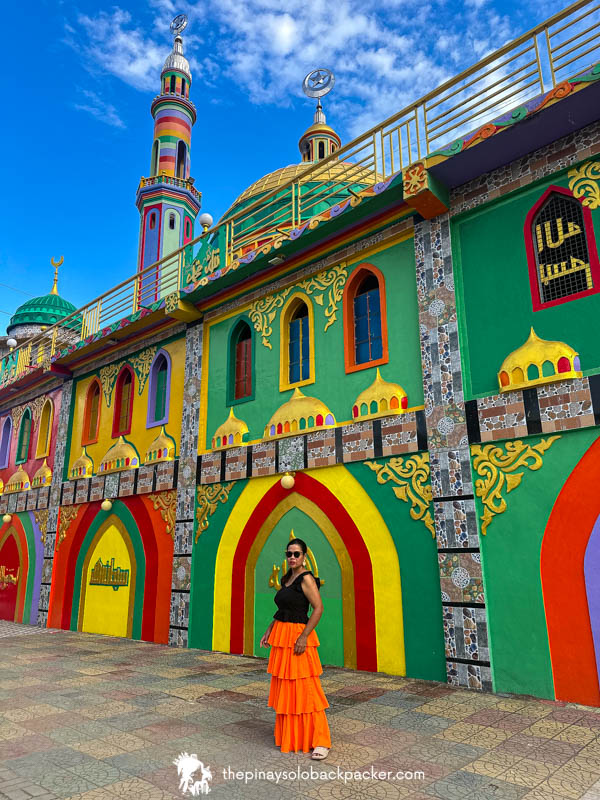
I visited because the colorful Rainbow Mosque caught my eyes. But I left thinking about why it was colorful – and what those colors were trying to say.
And perhaps that’s one of the best things about travel. Sometimes, you go somewhere looking for something beautiful. Yet you discover something meaningful instead.
In Zamboanga, the Rainbow Mosque taught me that color isn’t just something you see. Sometimes, it’s something a place uses to tell you who it is.
VISITING THE RAINBOW MOSQUE IN ZAMBOANGA: WHAT TO KNOW
If you are exploring Zamboanga City, adding the Rainbow Mosque to your Zamboanga Itinerary offers a masterclass in how communities reinvent themselves with grace.
Here are a few quick tips for a respectful and mindful visit:
- MOSQUE ETIQUETTE: As in any mosque, dress modestly, cover your shoulders and knees, and be mindful of prayer schedules. I wasn’t wearing the proper outfit so I didn’t enter the Rainbow Mosque. Always approach local caretakers with respect if you are engaging in conversation or documenting the space.
- BEST TIME TO VISIT: Aim for morning 8:00 AM – 10:00 PM or afternoon around 3:00 AM – 5:00 PM, rather than during major prayer periods. Mid-morning or late afternoon offers the most dramatic natural lighting for observation and photography, as the sun hits the painted dome at an angle.
HOW TO GET TO THE RAINBOW MOSQUE ZAMBOANGA
Here’s how to commute to the Rainbow Mosque in Zamboanga City:
BY TRICYCLE:
Take a tricycle to the Rainbow Mosque in Zamboanga city from downtown. The driver charged me ₱100/$1.59 for the one-way trip and the ride was only 10 minutes.
Tricycle fare in Zamboanga City starts at ₱35/$0.56 per 1-2 passenger, additional ₱10/$0.16 per additional passenger and ₱10/$0.16 for every succeeding kilometer. But most drivers don’t follow the fare matrix and Zamboanga City doesn’t seem to strictly enforce this, which is quite disappointing because even the locals are charged the same price!
Alternatively, you can use Grab Tricycle. Try to book via the Grab App because the price on the app is oftentimes more reasonable.
BY JEEPNEY:
Take a jeepney bound for TUMAGA. Fare is roughly (₱15/$0.24) per person. Tell the driver you are getting off at the Rainbow Mosque. Ride is about 10 minutes depending on where you’re coming from. Open Google Maps so you won’t miss it.
-
-
- Rainbow Mosque
- Address: Veterans Avenue Extension, Tumaga Road, Brgy. Sta. Maria, Zamboanga City
- GPS: 6°55’49.9″N 122°04’43.0″E
- Open Hours: Daily 8:00 AM – 5:00 PM
-
- Entrance Fee: FREE but donations for the mosque’s upkeep may be welcomed.
-
- How to get to the Rainbow Mosque in Zamboanga: Take a jeepney bound for TUMAGA. Fare is roughly (₱15/$0.24) per person. Tell the driver you are getting off at the Rainbow Mosque. Ride is about 10 minutes depending on where you’re coming from. Open Google Maps so you won’t miss it.
-
- Alternatively, you can just hire a tricycle to take you to the Rainbow Mosque. Tricycle fare in Zamboanga City starts at ₱35/$0.56 per 1-2 passenger, additional ₱10/$0.16 per additional passenger and ₱10/$0.16 for every succeeding kilometer. But most likely you will be asked to pay ₱50/$0.80 per passenger or ₱100/$1.59 if you are alone.
-
- Travel Tip: If you’re going to the Rainbow Mosque for sightseeing and taking photos, aim for morning 8:00 AM – 10:00 PM or afternoon around 3:00 AM – 5:00 PM, rather than during major prayer periods
-
✅ ZAMBOANGA CITY TOUR: RESERVE HERE
BUDGET HOTELS IN ZAMBOANGA CITY

Travel Tip: Use my promo codes for discounted rates.
✅ SOLOKLOOK – Klook
✅ SOLOAGODA (up to 5x use) – Agoda Hotels CLAIM CODE HERE
✅ PINAYSOLO (up to 5x use) – Agoda activities CLAIM CODE HERE
✅ PINAYSOLO (unlimited use) – Star Cruises
-
-
- WINZELLE SUITES
- Location: Lim Avenue, Zamboanga City
- RESERVE HERE
-
-
-
- EVER O BUSINESS HOTEL
- Location: Tomas Claudia Street, Zamboanga City
- BOOK HERE
-
-
-
- L MERIDIAN SUITES
- Location:Camins Avenue, Zamboanga City
- CHECK RATES HERE
-
-
-
- HOTEL PRIMERA
- Location: Canelar Moret Street, Zamboanga City
- BOOK HERE
-

GRAND ASTORIA HOTEL
On my recent trip to Zamboanga city, we were billeted at Grand Astoria Hotel. It’s located in the city center, so it’s quite a good location. However, the surrounding areas aren’t really inviting to explore and aren’t pedestrian-friendly. The hotel looks a bit timeworn, with an outdated interior. My room is a bit old and yes, it smelled old. But it has enough space for me to move, as well as store my luggage. Shower has consistent water, and more importantly there’s bidet. Towels and drinking water were provided. But it’s lacking toiletries – no soap or body wash. I didn’t ask to have my room cleaned for the duration of my stay because my stuff are all over and there’s no hotel safe where I can leave my laptop and external hard drives. Breakfast is decent, but be early or else you might be left with nothing. Lol It was festival season during our stay, so, I expected more staff at the dining since they have a lot of guests, but there seems to be one person doing all the work that time. Checking-in took longer than it should because there’s a bunch of guests since it’s festival week. Still, hotel should’ve been prepared for it. Staff are helpful but aren’t as warm and welcoming like in some hotels I stayed at before. You can find better hotels in the city for the same price.
-
-
- GRAND ASTORIA HOTEL
- Location: Mayor Jaldon Street, Zamboanga City
- RESERVE HERE
-